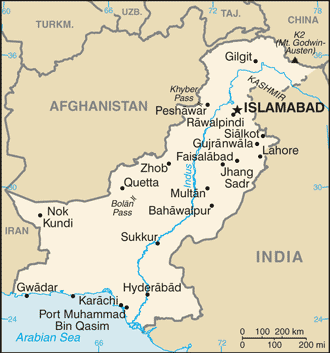
Map of Pakistan
The Maria-Helena Foundation is a non-profit, non-sectarian Pakistani-Canadian family-based organization that focuses on development in South Asia, primarily Pakistan. Our goal is to reduce poverty by supporting: education (especially of girls), skills training of women, and health care of children.
Profile of Pakistan
Pakistan is a Muslim majority, multi-ethenic country. The river Indus, the longest river in South Asia, is its life-line. The Indus valley civilization is the most ancient of ancient India – Mohanjo Daro and Harrapa, 5000 years old ruins, are its testimonials. Most likely the very names India and Indian Ocean are derived from “Indus”. The world’s second highest mountain, K2, is in Pakistan, and the country is also the birth place of Sikhism. Pakistan is the sixth most populous country, with a current population of about 220 million.
What We Do
1a. We fund construction of buildings used as educational facilities and skills training centres that:
- Provide quality primary education to girls and boys at low cost to poor children,
- Create employment and self-employment for poor women, and
1b. We offer half-fee scholarships to under-privileged students in primary schools. We have special scholarships only for girls in middle and high schools with emphasis on science for girls.
2. We offer free home-based education in a non-formal setting to children working as domestic servants, beggars, porters, and street hawkers, etc.
3. We provide basic health care to poor children and adults, and participate in immunization campaigns for children from poor families.
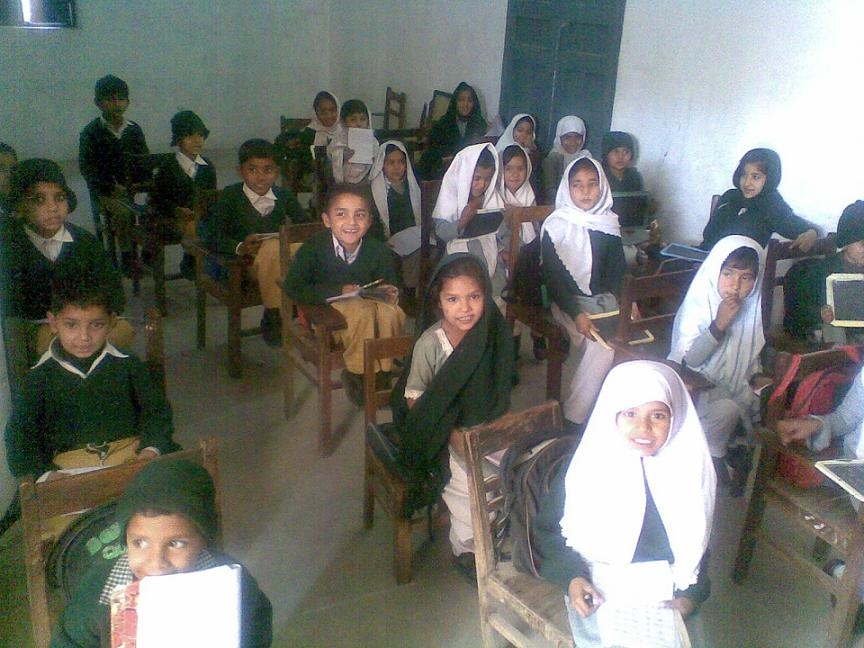
Classroom in Lilla School, District Jhelum
President and Contact Person:
Dr. Muhammad Iqbal #919 –4481 West 10th Avenue Vancouver, BC, V6R 4R8 Canada Email: iqbal[at]mail.ubc.ca Or Tahir Din, Treasurer tahir.mhf@gmail.comBoard Members:
- Ms. Kim Brown, B.A.
- Dr. Diane Fast, M.D., Ph.D.
- Dr. Isabeau Iqbal, Ph.D.
- Dr. Muhammad Iqbal, Ph.D.
- Dr. Bernard Mohan, Ph.D.
- Dr. Valerie Raoul, Ph.D.
- Mr. Yvon Raoul, M.A., B.Ed.
Registered Charity # 89250 2725 RR0001 – Incorporated in 1999
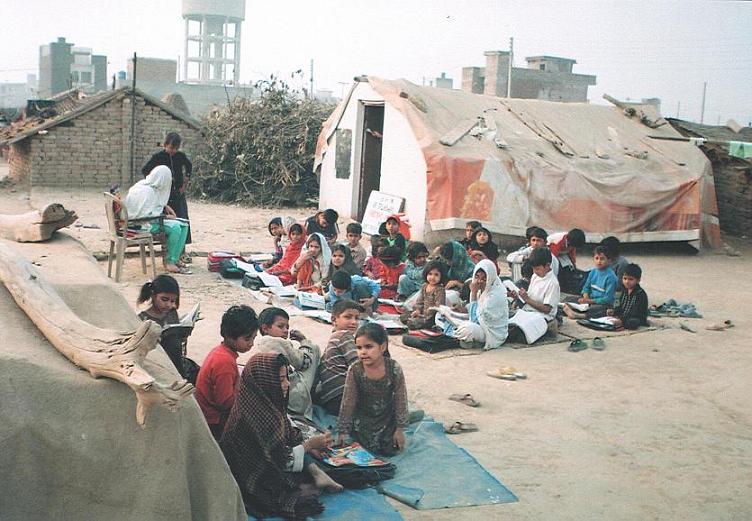
One-room one-teacher school for gypsy children
What we have done?
Pakistan ranks very low in all human development indices. In addition, women have an inferior position in that patriarchal society. Poverty and ignorance are at the root of many of Pakistan’s problems. It is known that primary education and primary healthcare are essential foundations in reducing poverty.
In partnerships with Pakistani civil society organizations, the Foundation has helped establish:
- 20 permanent self-sustaining primary co-educational schools with an enrollment of about 3,500 students. One more school is planned. Mainly all teachers are women. We help build one new school every year. Land is donated by the local community. Each school costs about $70,000. All schools follow the Government approved curriculum.
- 15 one-room one-teacher co-educational primary schools meant for the extremely poor. All expenses are paid by the Foundation. Each school costs about $1,200 a year to operate. About 450 students are enrolled. All schools are in Bahawalnagar villages.
- 1 out-patient medical clinic where about 80 patients per day receive treatment at very low fees.
- 2 one-to-three-room vocational training centres in which young girls and women learn traditional needlecraft and sewing. This training helps the invisible household economy. It requires about $6,000 as capital cost to establish one such vocational school, and $1,000 per year for five years for operational expenses. After five years the school becomes self-sustaining.
- A new scholarship program to honour the late Professor Abdus Salam, Pakistan’s only Nobel laureate. These scholarships at $15 per month, will be only for girl science students in Grades 9 and 10.
- 2 primary school libraries. Each library costs approximately $1,000.
- 10 Interns trained. Every year we take a young person, usually a recent graduate in Political Science, who spends an year of training on a part-time basis, in International Development in our Vancouver office.
- $1.8 million raised since inception in 1999
To see an infographic about the Maria-Helena Foundation, click here.
What can you do?
Donate to the MHF itself
Our current costs are:
- $300: for one child’s (5 yr) education in a primary school @ $5 per month tuition fee
- $3,600: for primary education of 30 working children in a home-school operating on an accelerated three-year academic cycle
- $70,000: to establish a permanent self-sustaining primary school built on land provided by the community
- $40-$60/month: a teacher’s salary.
click here to download a donation form (we provide tax receipts for any sum above $10)
Check us out at the Canada Revenue Agency:
http://www.cra.gc.ca/charities
Or phone: 1-800-267-2384
We are a member of the British Columbia Council for International Cooperation: www.bccic.org